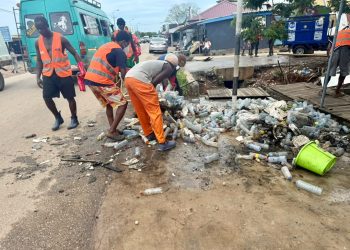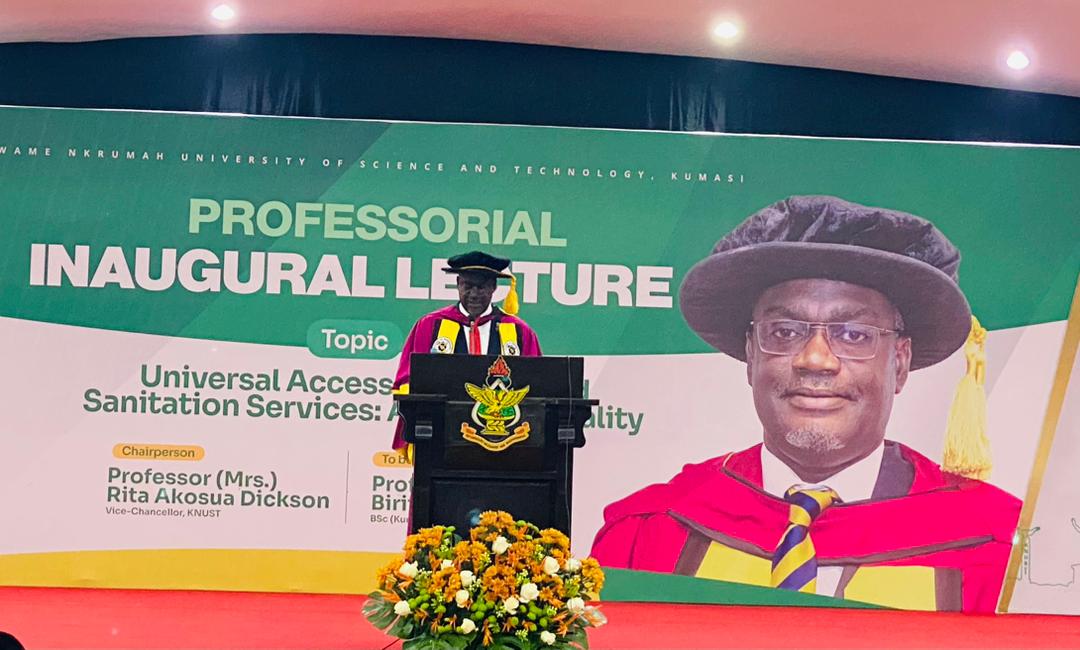
A lecturer at the Kwame Nkrumah University of Science and Technology (KNUST) has proposed the development of a national faecal sludge management strategy to guide Metropolitan, Municipal and District Assemblies to ensure safe and proper collection, transportation and disposal.
Extensive research in water and sanitation by Professor Kwabena Biritwum Nyarko revealed that managing faecal sludge remains a major challenge for many households in Ghana especially in rural communities and small towns.
Faecal sludge contains pathogens and could pose significant health risks if not properly managed or treated. However, it also contains valuable nutrients that can be recovered to enrich the depleting soil.
Delivering a professorial inaugural lecture on the topic “Universal Access to Water and Sanitation Services: A Myth or Reality?” at the KNUST, Professor Kwabena Biritwum Nyarko highlighted as part of his recommendations the development of a national faecal sludge management strategy.
He said, “To address the problem of untreated and unsafe disposal of faecal sludge, a national Liquid Waste Management Strategy incorporating a Fecal Sludge Management (FSM) Programme is warranted”.
The research also revealed that 60% of the population dispose of their grey water by throwing it on the ground or the streets, 27% dispose of theirs by allowing it to flow into the gutters, 11% dispose of theirs by channelling them into soaked pits (soak-away) while only 2% dispose of their grey water through proper sewage systems.
Prof. Biritwum Nyarko indicated that untreated grey water remains polluted, presents substantial environmental risks in Ghana, and makes it difficult to ensure universal access to sanitation.
He said “Grey water management is a serious concern and demands attention from stakeholders, especially in a situation where less than 5% of Ghana’s population had access to sewage systems,” He also urged the Ministry of Sanitation and Water Resources to Integrate grey water management in water and sanitation programming.
As Ghana makes efforts to achieve the Sustainable Development Goals (SDGs) 6.1 and 6.2 ensures universal access to water and sanitation by 2030, many remain sceptical about the slow pace at which this will be realized by policymakers.
A 2022 report by the Ghana Statistical Service indicated that 1.4 million Ghanaians depend on surface water with only 37% of the population (12.5 million Ghanaians) using sachet water while 56% of the population has access to improved water supply. In the area of sanitation, 8 million people are reported to use public toilets in Ghana with 11 million people sharing toilets with neighbours while open defecation has increased from 3.4m to 5.7m.
However, Ghana still faces substantial challenges in achieving its policy commitments on water and sanitation. These improvements, however, have been limited by several persistent challenges, which have been exacerbated by population growth, urbanization, and climate change.
There are also significant disparities in access that underscore the gap between Ghana’s SDGs 6.1 and 6.2 commitments and the current reality.
The research also highlighted the main challenges to expanding access to the unserved population without water and sanitation services; a task which becomes more complex due to the need for enhanced sustainability of systems as service delivery approaches full coverage.
Prof. Kwabena Nyarko during the inaugural lecture recommended the need for the government to invest in research, development, and innovation to generate solutions to address the water and sanitation challenges in areas including financing, technology options, institutional design, and marketing to ensure effective implementation and sustainability.
Explore the world of impactful news with CitiNewsroom on WhatsApp!
Click on the link to join the Citi Newsroom channel for curated, meaningful stories tailored just for YOU: https://whatsapp.com/channel/0029VaCYzPRAYlUPudDDe53x
No spams, just the stories that truly matter! #StayInformed #CitiNewsroom #CNRDigital