



The national outlook of the 2024 General Elections saw the National Democratic Congress (NDC) sweeping the political landscape and making history by claiming dominance even in traditional New Patriotic Party (NPP) strongholds. This resounding call for change echoed across the country as the NDC amassed an impressive 6,591,790 votes, decisively defeating the NPP’s 4,877,611 votes from 11,931,420 ballots cast. In Parliament, the NDC solidified its mandate with a significant 183 seats, leaving the NPP with just 88 seats, along with four independent representatives.
Yet, amidst this wave of change, the North East Region stood out as an anomaly. Defying the national trend, the region tipped the scales in favour of the NPP, delivering a surprising twist to an otherwise one-sided electoral outcome.
________________________________________
Ghana’s North East Region
The Northern Region of Ghana was split into Northern, North East, and Savannah regions in 2018, following a referendum designed to boost decentralisation efforts in these areas. This fulfilled a key promise made by the NPP during their 2016 election campaign. The North East Region is bordered by the Upper East Region to the north, the Ghana-Togo border to the east, the Northern Region to the south, and the Upper West Region to the west.
The region has a voter population of 339,885, which is spread across six constituencies:
• Bunkurugu
• Chereponi
• Nalerigu/Gambaga
• Walewale
• Yagaba/Kubori
• Yunyoo
These six constituencies have been divided into the following ethnic divisions:
• The Mamprusi dominate Nalerigu/Gambaga, Walewale, and Yagaba/Kubori constituencies.
• The Bimoba, Chokosi, and other minor tribes inhabit Yunyoo, Chereponi, and Bunkurugu.
________________________________________
Ethnicity and Voting Patterns
Since Ghana’s return to democratic rule in 1992, the North East Region (formerly part of the Northern Region) has consistently leaned towards the NDC. This trend was largely due to the works of late President Jerry John Rawlings, founder of the NDC, who made deliberate efforts to support and amplify the image and development of the North, a marginalised region for so many years.
He spearheaded initiatives that resonated deeply with Northerners, including significant investments, such as the extension of electricity to Northern Ghana in 1989, and the promotion of the region’s traditional attire, the “fugu,” which he wore to formal events, giving it international recognition. Additionally, in 1993, Rawlings used his US$50,000 Hunger Project prize as seed money to establish the University of Development Studies in the North to boost education in the region. For inhabitants in this region, the move presented the NDC as an inclusive and responsive option for Northerners. However, a noticeable shift occurred in 2012 when the NPP began to see a steady rise in its numbers within the region. This development raises the question: what accounted for this sudden change?
Political analysts point to the influence of Dr Mahamudu Bawumia, who became the running mate of President Akufo-Addo in 2008 and has been a central figure in NPP politics since. Although the NDC maintained its dominance in the 2008 elections, the NPP began gaining traction in the North East Region by 2012. Although the NDC narrowly won the presidential race in that year, the parliamentary results favoured the NPP, as they gained majority with four seats: Walewale, Yagaba/Kubori, Chereponi and Bunkurugu, while the NDC had only two seats, Nalerigu/Gambaga and Yunyoo constituencies.
Dr Bawumia’s influence is widely credited for this shift because evidently, the wave of change for the NPP blew across the Mamprusi division of the six constituencies within the North East Region. Therefore, with Bawumia being a Mamprusi man and a native of Walewale, he appealed to voters in the region, leveraging ethnic ties to build the NPP’s popularity.
The outcome of subsequent elections in 2016, 2020, and 2024 has seen the NPP retaining its dominance in the North East Region, a trend that will be explored further in the course of this article.
For the NDC, the introduction of John Dramani Mahama, in 2008, as running mate to the late Prof. John Evans Atta Mills, similarly boosted the party’s appeal in his home region, the Savannah Region (also formerly part of the Northern Region). Even through his candidacy as President from 2012 to 2024, his dominance in the Savannah and Northern Region, has not affected Bawumia’s influence in the North East Region.
While previous Northern candidates for the NPP, such as the late Aliu Mahama, Vice President during President Kufuor’s tenure, played vital roles in mobilizing votes in Northern Ghana, Dr Bawumia’s influence and popularity in the North East Region have proven particularly significant.
________________________________________
Electoral Trends in the North East Region: 2012–2024
In 2012, Nana Akufo-Addo and Dr Bawumia contested the Presidential seat for the NPP, while John Dramani Mahama and Amissah-Arthur contested for the National Democratic Congress (NDC). At the end of the polls, the NDC emerged victorious in the North East Region with 85,283 votes (52.13%), while the NPP secured 73,384 votes (44.86%), resulting in an 11,899 vote margin in favor of the NDC.

Interestingly, this election reflected a “skirt and blouse” voting pattern, where the NPP, despite losing the presidential race, won the majority of parliamentary seats in the region—four seats against the NDC’s two.

The 2016 elections marked a turning point for the NPP in the North East Region. Their message of rallying behind a candidate from the region, Dr Bawumia, began to resonate strongly with voters. For the first time since 1996, the NPP won the presidential race in the region. Nana Akufo-Addo garnered 94,066 votes (50%), narrowly defeating John Dramani Mahama, who secured 92,395 votes (48.50%), with a slim margin of 1,671 votes. This historic victory was primarily secured by strong performances in the Walewale and Nalerigu/Gambaga constituencies.

However, the parliamentary results told a slightly different story. The NPP experienced a net loss of one seat, bringing their tally to three, while the NDC gained one seat, also reaching three constituencies.

By the 2020 elections, the NPP widened its presidential margin in the region. Nana Akufo-Addo garnered 122,742 votes (51.33%), while John Dramani Mahama received 112,306 votes (46.97%). The parliamentary results mirrored the 2012 outcome, with the NPP reclaiming its majority, winning four seats, while the NDC held two.

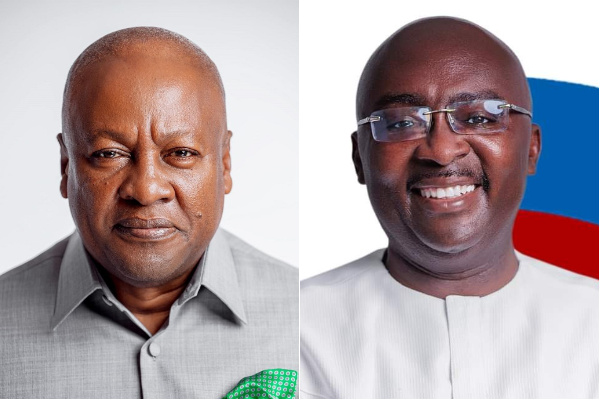
The 2024 elections were even more intriguing due to the unique dynamics of having two Northern candidates leading the major parties: Dr. Mahamudu Bawumia (NPP), a Mamprusi, and John Dramani Mahama (NDC), a Gonja.
This historical moment meant Northern electorates had to choose between two leaders from their own region, sparking heightened interest in the election. Out of 339,885 registered voters, 258,387 votes were cast. Dr. Bawumia, leading the NPP, secured 134,800 votes (54.06%), outperforming Akufo-Addo’s 2020 performance in the region by 12,058 votes. John Mahama, representing the NDC, received 111,051 votes (44.54%).At the parliamentary level, the trend from 2020 persisted. The NPP lost one seat, reducing their tally to three, while the NDC gained one, also securing three seats.

This equilibrium underscored the competitive nature of politics in the North East Region, with ethnic affiliations and regional representation playing crucial roles in voter decisions.
________________________________________
Stronghold Constituencies
For the NPP
• Walewale: Since 2012, the Walewale Constituency has consistently favored the NPP, largely due to the “Bawumia factor.” Dr Bawumia, being a Mamprusi man and a native of Walewale, has significantly influenced the constituency’s loyalty to the NPP.
• Yagaba/Kubori: This constituency has also leaned toward the NPP, except for a deviation in the 2016 elections.
For the NDC
• Bunkurugu and Yunyoo: Both constituencies have remained strongholds for the NDC since 2012, maintaining a predominantly pro-NDC stance.
Swing Constituencies
• Nalerigu/Gambaga and Chereponi: These constituencies have exhibited a swing pattern at the presidential level, with no consistent dominance by either party.
Conclusion
The North East Region has become an interesting case study in Ghana’s electoral politics, showing the relationship between ethnicity and political strategy.
As Ghana continues to navigate its democratic journey, the North East Region will undoubtedly remain a crucial battleground, reflecting broader national trends and the enduring influence of ethnicity in shaping voter behaviour.