• About Us
  • Privacy Policy
  • Terms of Use
  • Breaking News
  • Explainers
  • Listen Live
Thursday, June 11, 2026
Citinewsroom - Comprehensive News in Ghana
Advertisement
  • Home
  • News
    • Regional News
      • Ahafo Region
      • Ashanti Region
      • Bono East Region
      • Bono Region
      • Central Region
      • Eastern Region
      • Greater Accra Region
      • Northern Region
      • North East Region
      • Oti Region
      • Savanna Region
      • Upper East Region
      • Upper West Region
      • Volta Region
      • Western Region
      • Western North Region
  • Sports
    • World Cup
  • Politics
  • Business
  • Entertainment
  • Articles
  • Explainers
  • Editorials
No Result
View All Result
Citinewsroom - Comprehensive News in Ghana
  • Home
  • News
    • Regional News
      • Ahafo Region
      • Ashanti Region
      • Bono East Region
      • Bono Region
      • Central Region
      • Eastern Region
      • Greater Accra Region
      • Northern Region
      • North East Region
      • Oti Region
      • Savanna Region
      • Upper East Region
      • Upper West Region
      • Volta Region
      • Western Region
      • Western North Region
  • Sports
    • World Cup
  • Politics
  • Business
  • Entertainment
  • Articles
  • Explainers
  • Editorials
No Result
View All Result
Citinewsroom - Comprehensive News in Ghana
No Result
View All Result

Citi News Explainer | Why exchange rates at banks and forex bureaux are higher than BoG’s

Nii Larte LarteybyNii Larte Lartey
June 2, 2025
Reading Time: 3 mins read
ShareShareShareShare

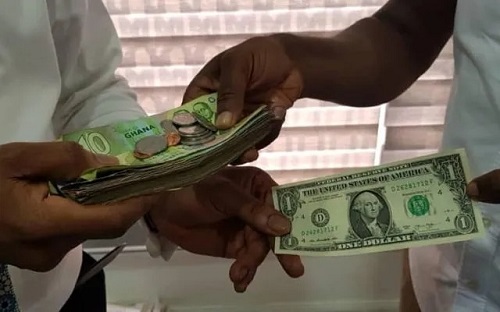
Ever wondered why you are paying more for forex than the rates the Bank of Ghana (BoG) publishes? The answer simply lies in how foreign exchange works in practice.

Per the Bank of Ghana’s official figures, the cedi closed trading last week at GH₵10.28 to the US dollar, GH₵13.86 to the British pound, and GH₵11.67 to the euro.

But for those who sourced foreign currency from retail channels like banks and forex bureaux, it was costlier in that same period.

A dollar exchanged hands at GH₵10.80, while the pound and euro were going for GH₵14.60 and GH₵11.90, respectively – clearly above the BoG’s rates.

The difference is because foreign currency is treated like any tradable commodity and it’s subject to the forces of demand and supply in what’s known as the foreign exchange (FX) market. 

This means, just like any other market, prices can vary depending on where, how and in what volumes the currency is being traded.

“An exchange rate is the price of one country’s currency in terms of another currency. Generally, there are two systems of quotation. We have a direct quote system and an indirect quote system”, Nelson Cudjoe Kuagbedzi, Finance and Tax Expert and Head of Finance at Merban (UMB) Capital Limited explains. 

Ghana uses a direct quote system, where the exchange rate is expressed as the amount of Ghana cedis needed to buy one unit of foreign currency — for example, USD 1 = GHS 12.20 (buy) – GHS 12.50 (sell). 

Under this system, banks buy low and sell high by adding their margins to cover operational costs and make a profit.

The buying rate are quoted for exporters while the selling rate are quoted for importers. 

In contrast, an indirect quote system, used in some other countries, expresses the value of local currency per unit of foreign currency. 

Why higher rates than BoG’s?

The Bank of Ghana sells foreign exchange in bulk to commercial banks, often at slightly lower rates due to the large volumes involved and pricing typically more competitive.

Conversely, forex bureaux deal with smaller volumes and higher transaction risks. 

Since demand often outpaces supply, banks and forex bureaux, however, add a margin when they retail the FX to individuals and businesses – accounting for service costs, market risks and desired profit making prices higher.

There is also the interbank market, where banks trade FX among themselves. 

These transactions are subject to real-time market dynamics; meaning rates fluctuate based on who needs foreign exchange and how urgently.

The BoG calculates and publishes the spot weighted median rate based on all interbank transactions at the end of trading each day.

This rate on the Central Bank’s website is meant to only serve as a benchmark – not a retail price and doesn’t include the markups added by banks or forex bureaus for smaller, retail-level transactions.

Some commercial banks and bureaux could add as high as a 7% mark-up to the rate.

Put simply, the BoG’s published rate is a reference point, not a guaranteed retail price. 

So, the final rate you get at the counter has been computed based on trading volumes, margins and real-time market pressures.

These are all factors that make buying foreign currency more expensive on the open market than it appears on paper.


Tags: Bank of GhanaCediExchange rateforex bureauGhana News
ShareTweetSendSend
Previous Post

2025 Citi Business Festival officially kicks off; week one focuses on Personal Finance

Next Post

Cedi to gain as Ghana awaits $370m IMF tranche to boost reserves

Related Posts

Business

Ian Greenstreet takes helm at Ghana International Bank following CEO change

June 11, 2026
Business

Citi Business Festival: AfCFTA takes centre stage at first roundtable discussion today

June 11, 2026
File image
Featured

US uncovers Birth Tourism Network in West Africa, revokes more than 100 visas

June 11, 2026
A relative of a patient allegedly assaults a midwife at the Tema Community 22 Polyclinic.
Featured

MoH hails court ruling in Community 22 Polyclinic assault case

June 11, 2026
Business

Prestea Sankofa Limited secures Chinese partnership to double gold output

June 11, 2026
Business

Services sector emerges as key driver of first-quarter GDP growth

June 11, 2026
Next Post

Cedi to gain as Ghana awaits $370m IMF tranche to boost reserves

ADVERTISEMENT
Citinewsroom - Comprehensive News in Ghana

CitiNewsroom.com is Ghana's leading news website that delivers high quality innovative, alternative news that challenges the status quo.

Archives

Download App

Download

Download

  • About Us
  • Privacy Policy
  • Terms of Use
  • Breaking News
  • Explainers
  • Listen Live

© 2024 All Rights Reserved Citi Newsroom.

No Result
View All Result
  • Home
  • News
    • Regional News
      • Ahafo Region
      • Ashanti Region
      • Bono East Region
      • Bono Region
      • Central Region
      • Eastern Region
      • Greater Accra Region
      • Northern Region
      • North East Region
      • Oti Region
      • Savanna Region
      • Upper East Region
      • Upper West Region
      • Volta Region
      • Western Region
      • Western North Region
  • Sports
    • World Cup
  • Politics
  • Business
  • Entertainment
  • Articles
  • Explainers
  • Editorials

© 2024 All Rights Reserved Citi Newsroom.