It’s the most prescribed antibiotic in the United States, used by tens of millions of people every year to treat bacterial infections including pneumonia, stomach ulcers, and strep throat.
Yet, it isn’t exactly common knowledge that amoxicillin, a relative of penicillin that has been in chronic short supply, has only one manufacturer in the US, or that China controls 80% of the raw materials required for its production.
That’s a major concern as US President Donald Trump threatens to impose tariffs on pharmaceutical imports, throwing a spotlight on America’s dependence on critical drug supplies from abroad.
“Increasing trade hostilities or more protracted conflicts could devastate our access to amoxicillin or the ingredients used to make it should Beijing weaponize its supply chain dominance,” Rick Jackson, founder and CEO of Jackson Healthcare, which owns America’s sole amoxicillin manufacturer, told CNN.
Last year, 96% of US imports of hydrocortisone (the active ingredient in the anti-itch cream), 90% of imports of ibuprofen (found in common over-the-counter pain relievers), and 73% of imports of acetaminophen (in other kinds of pain relievers) all came from China, according to CNN calculations based on trade data from the Census Bureau.
With the US already facing shortages of many essential medications, experts warn that Beijing could potentially exploit this reliance as leverage in an escalating trade war. Tensions between the two sides have soared since Trump unleashed his trade assault on the world’s second-largest economy.
While the two countries have announced a temporary truce that rolled back the three-digit tariffs for 90 days, relations remain tense with ongoing feuding over chip restrictions imposed by the US.
Leland Miller, a commissioner at the US-China Economic and Security Review Commission, said the “chokepoints” that China holds over the US pharmaceutical supply are “detrimental to American security.”
“Simply by having this leverage … whether or not they ever pull the trigger, causes us to change our policy positions on a lot of things, and that’s not good,” he said.
So far, China has made no official public threat about weaponizing its dominant position in this segment of the pharmaceutical industry. But Trump’s tariffs on the sector, if imposed, could worsen existing drug shortages and drive up prices for Americans, undermining his promise to lower health care costs.
Generic drugs, which are designed to provide the same therapeutic effects as brand-name ones and are released after their patents expire, account for 90% of all prescriptions in the US. India produces many of those generics, often from ingredients imported from China.
Even though industry insiders and experts widely acknowledge America’s heavy reliance on Chinese pharmaceuticals, there is little comprehensive data on the full extent of this dependence across the sector, as major pharmaceutical firms have little incentive to disclose such information.
That’s part of the reason why last month, the Trump administration launched a probe into pharmaceuticals imports as part of efforts to impose tariffs on the sector on national security grounds.
A ‘catastrophic’ interruption
With China making 80% of the world’s raw materials for amoxicillin, according to Jackson, it’s a clear example of just how vulnerable the world could be to “Chinese political or economic whims.”
“Any interruption by China along the lengthy amoxicillin supply chain could be catastrophic, particularly in the face of a potential bacterial epidemic,” he said.
In 2021, Jackson purchased a bankrupt manufacturing site located in Bristol, Tennessee, and renamed it USAntibiotics. The facility, built in the 1970s, used to produce enough amoxicillin for the whole country at the time.
After the amoxicillin patent expired in 2002, the Tennessee facility began to make generic equivalents. At that point, it began facing lower-cost competition from overseas and eventually went bankrupt.
Concerns about America’s dependence on Chinese pharmaceuticals aren’t new. As early as 2019, the US-China Economic and Security Review Commission recommended that Congress assess America’s pharmaceutical vulnerabilities. Two years later, when Jackson bought the amoxicillin factory, he cited national security and the need to ensure a steady supply of antibiotics as a major reason for the purchase.
Still, progress in growing America’s pharma supply chain has been slow. In late April, Trump said pharmaceutical companies were “going to have to” produce drugs in the US or face a “tariff wall.”
A key goal behind Trump’s threats of pharmaceutical tariffs is to “onshore” drug production. An American study in 2021 found that the US imports 72% of its essential medicines.
But experts said tariffs are unlikely to achieve that goal for generics, which have become commodities, with price being the main differentiator. So-called brand-name drugs, by contrast, are protected by patents and therefore command higher prices and bigger profit margins.
Instead, tariffs would not only drive up medical costs for patients, but they could also exacerbate ongoing drug shortages by pushing generic drug makers out of the American market. Even if they are willing to build drug-making facilities in the US, the process could take years.
Reliance on China
China’s dominance in the global drug supply chain is part and parcel of its position as the world’s factory. Over decades, the pursuit of lower production costs has prompted drug makers to shift production from Western countries to places like China and India.
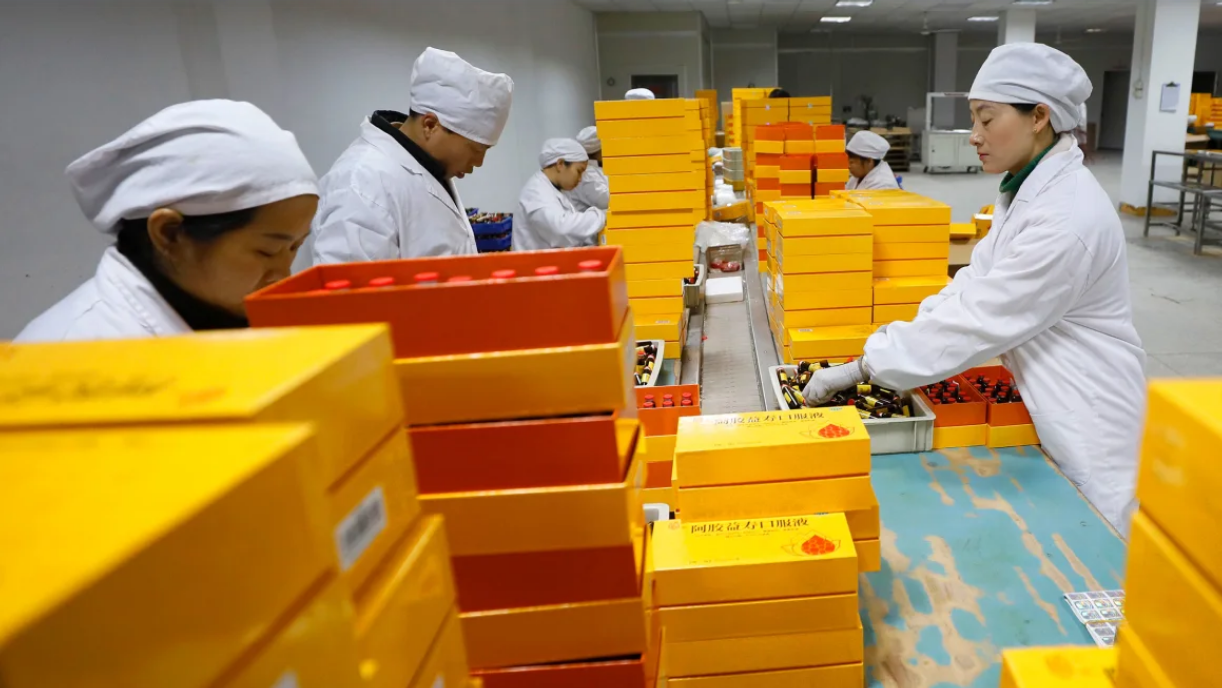
China plays an outsize role in the drug supply chain for its significant production of the critical chemical compounds, called key starting materials or KSM, which are necessary to produce active ingredients, called active pharmaceuticals ingredients or API.
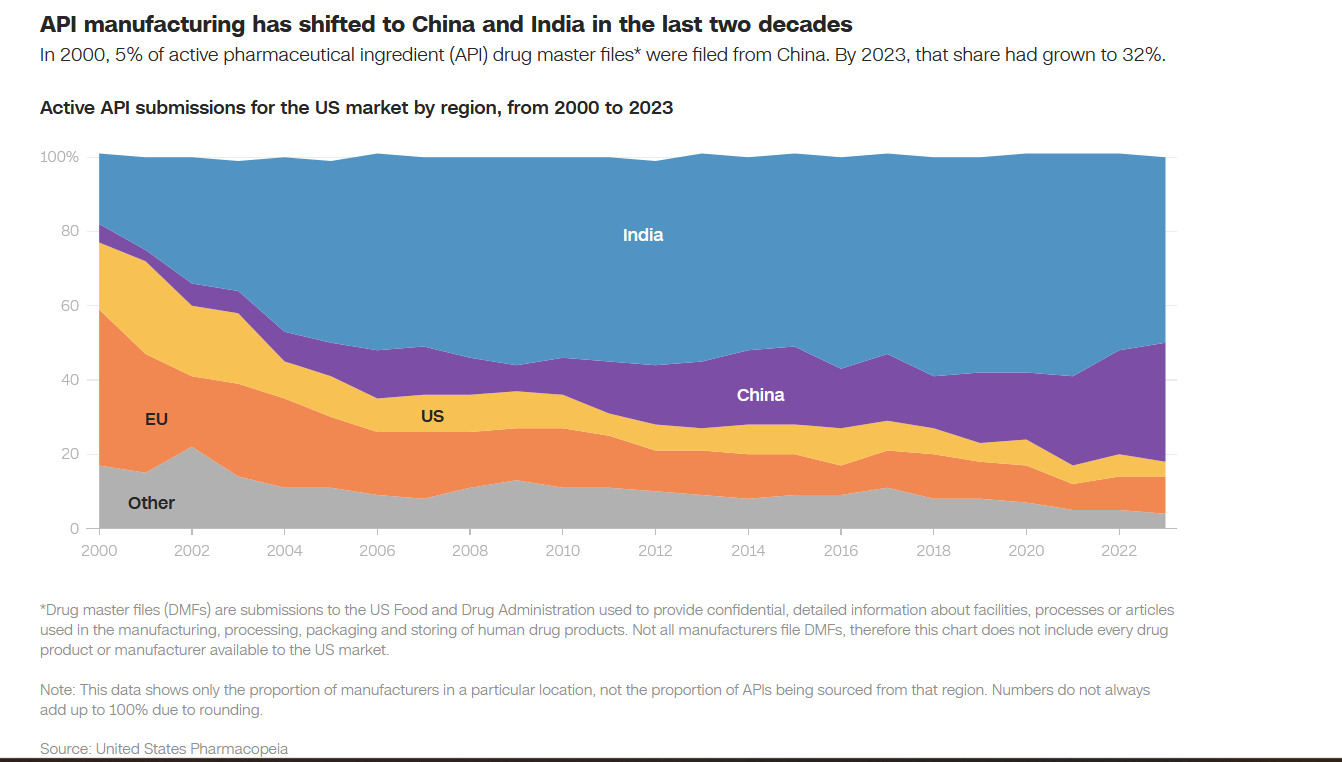
China and India dominate the global manufacturing capacity for API. Together, they account for 82% of all API manufacturer filings to the US Food and Drug Administration, according to United States Pharmacopeia (USP), a nonprofit that sets official quality standards for medicines. The filings contain detailed information about the facilities and manufacturing processes submitted by API manufacturers. In the two years after 2021, according to the most recent data, India’s share of the filings dropped to 50%, while China’s surged to 32%.
 Chinese manufacturers have also benefited from Beijing’s policy incentives and subsidies for the pharmaceutical sector since the early 2000s, which led to industry clusters springing up in the country, said Qingpeng Zhang, an associate professor at the University of Hong Kong’s LKS Faculty of Medicine.
“These industry clusters, which help drive down overall costs while maintaining quality … ultimately made China an ideal location for the production of generics and APIs within a free trade environment,” he said.
Besides lower costs, the environmental impact of drug production also contributed to China’s rise in this sector, as the US and European Union often have stricter environmental regulation, according to Ronald Piervincenzi, CEO of USP.
Even India, the world’s top supplier of generics, relies on China for APIs and other key ingredients. In fact, 70% of India’s API imports come from China, according to a 2023 report commissioned by the Indian government.
Dinesh Thakur, a public health expert and author of “The Truth Pill,” a book on Indian drug regulations, said that India’s reliance on China for drug materials reflected the “natural evolution” of the industry.
At the time when Indian drug companies moved up the value chain toward higher-margin products like formulations and injectables, China’s nascent pharmaceutical sector made inroads with API production at a lower price point, he said.
The Indian companies then “bought the API for a lesser cost from China and focused their money and their capacity in India on building competence for developing more complex finished formulations,” Thakur said.
He added that China’s well-established chemicals industry, built independently of pharmaceuticals, also gave its manufacturers a head start in producing drug-related chemicals.
Major policy push
Besides its cost advantage, China’s pharmaceutical industry also got a boost from the government. In 2015, Chinese leader Xi Jinping unveiled his signature “Made in China 2025” industrial strategy, which identified biopharma and advanced medical products as key sectors for development in its broader push to reduce the country’s reliance on foreign technology.
The Covid-19 pandemic further exposed global dependence on China for pharmaceutical supplies – and served as a reminder to Beijing of the strategic advantage that that dominance provides.
In a state-run magazine in 2020, Xi said China must consolidate its leadership in its advantageous industries, and “tighten global industrial chains’ dependence on China to build strong countermeasures and deterrent capabilities against deliberate external supply cutoffs.”
In 2021, during the height of the epidemic, China’s National Development and Reform Commission, the state planner, highlighted APIs as a “key strength in China’s pharmaceutical industry’s participation in global competition.”
Li Daokui, a professor of finance at Tsinghua University in Beijing and a Beijing adviser, even suggested that China, given its strategic position in the production of raw materials for vitamins and antibiotics, could limit drug supplies to the US as “countermeasures” against American sanctions.
‘Not effective’
While Trump is not the first US president to push for onshoring drug production, he is the first to attempt it through the threat of sweeping tariffs. Some companies have fallen in line.
British firm AstraZeneca, for instance, is shifting production of certain medicines from Europe to the US, following a $3.5 billion investment plan announced late last year. Similarly, companies including Johnson & Johnson and Eli Lilly have pledged to expand their US operations.
But these companies primarily focus on patented drugs. Stephen Farrelly, global head of pharma and healthcare at Dutch bank group ING, noted that the US accounted for 44% of global pharmaceutical sales in 2023, making it imperative for makers of patented drugs to maintain a presence in the country. The story is different for generics because their margins are often half those of branded ones.
“Given their margin profiles, they can’t afford to make long-term investment decisions with so much uncertainty around,” he said. “If even possible, it would take in excess of five years to begin reshoring.”
Tariffs on pharmaceuticals would eventually fall on patients, experts say, widening health disparities in an already strained health care system. Because generics are as much as 85% cheaper than branded drugs, low-income patients and those without health insurance rely on them disproportionately.
An April study commissioned by the main American pharmaceutical lobby group, the Pharmaceutical Research and Manufacturers of America, revealed that a 25% tariff will increase costs of imported pharmaceuticals by $50.8 billion annually, causing prices to rise by 12.9% if passed to consumers.
ING also found that a 25% tariff on a common generic cancer medication could raise its price by up to $10,000 for a 24-week prescription.
Rather than achieving the intended goal of onshoring production, experts said the tariffs could risk pushing generics manufacturers to abandon the US market altogether. Piervincenzi warned that even modest tariffs could disrupt the supply of generics.
“There’s very little profit there and any tariff would just result in [generic drug makers] being underwater and just exiting,” he said.
Incentives other than tariffs are necessary to create a resilient drug supply chain, Piervincenzi said. And unlike with other industries, drug supply disruption or shortages could have life-threatening consequences.
“Each of these drugs, people’s lives depend on them, and a single drug goes into shortage and a child can’t get their cancer therapy, and it becomes a disaster, which you don’t see if your favorite brand of ketchup’s out of stock,” he said. “You may be annoyed, but your life is not in danger.”
Source:CNN.com