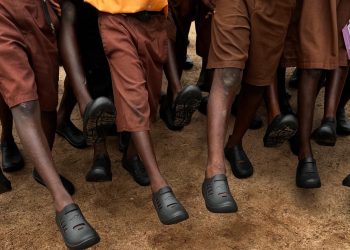
Over 3,000 schoolchildren in Ghana’s Central and Eastern Regions received brand-new antimicrobial World Shoes during a coordinated four-day campaign led by Samaritan’s Feet Ghana in partnership with US-based nonprofit Healthier Soles.
The four-day “Shoes of Hope” distribution campaign kicked off on July 8 in the Akwamufie community (Eastern Region), where 700 shoes were handed out to students at Akwamufie Presby School and the Community Vocational School, with several community members receiving pairs as well.

The MP for the district, together with some Local leaders, were in attendance, which depicted strong community support for the initiative.
On July 10, the team proceeded to the Central Region, where 767 pairs were distributed in the rural community of Kankaboom, and Kwaprow in partnership with The Komenda Project.
In Kankaboom, especially, the team’s presence discovered some children walking miles to school and other parts of town in slippers and some without shoes at all, with the majority suffering serious foot injuries. This problem clearly underscored the urgent need for our intervention.

The campaign reached its peak on July 11 in Nsawam (Eastern Region), where 2,280 school children across seven basic schools and community members received new shoes.
In Nsawam, our partnership extended to include Charisma Community Baptist Church, General Dodd Ministries and Inspiration Co. This event also featured a medical outreach led by OKB Hope Foundation and offered pressure and glucose blood screenings for the townsfolk, as well as general check-ups with laboratory exams.
The World Shoes are particularly unique; constructed from closed-cell EVA with antimicrobial properties, and are engineered to prevent foot-borne diseases and suit the harsh rural terrain.
Moreover, the shoes raise minimal environmental concerns due to the inclusion of biodegradable materials in their design. Alongside the footwear, proper hygiene and hand-washing sessions were conducted to teach the school children and foster long-term healthy practices.
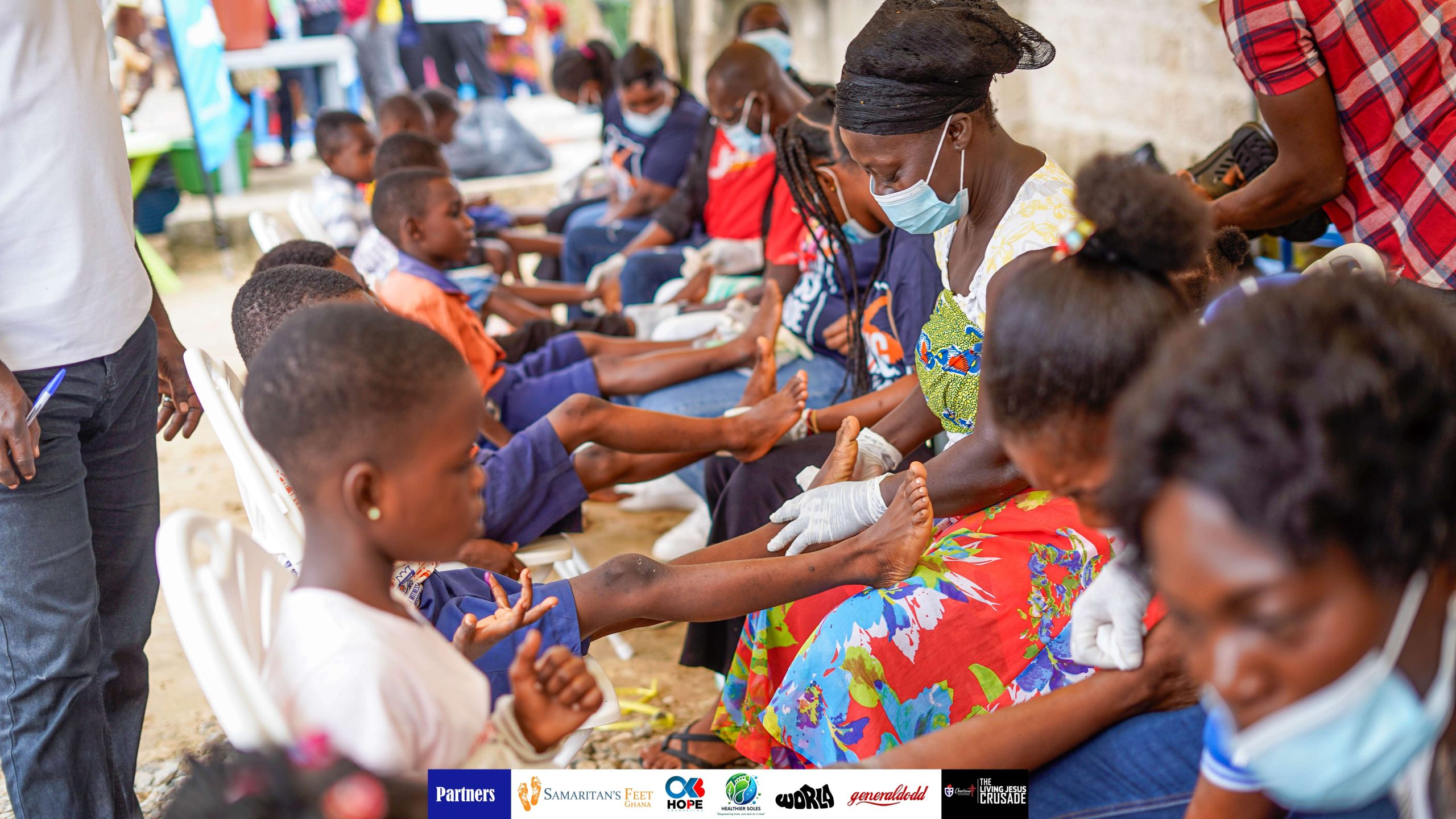
The “Wash & Wear” service – where volunteers, teachers, church-based groups, and community leaders cleaned children’s feet and ensured proper fitting, added a compassionate and humane touch to the campaign, empowering the children and reinforcing their dignity.
What made this distribution remarkable was the involvement of American teenage co-founders of Healthier Soles – Simar Kantor and Arav Makadia, who led fundraising efforts in the United States and travelled to Ghana with their families to take part in the four-day campaign.
Together with their parents and siblings, they actively washed feet and fitted shoes for recipients, adding an inspiring element and intergenerational diversity to the mission.
The program’s core message reinforces Samaritan’s Feet Ghana’s mission of removing barriers to education, one pair of shoes at a time.
CEO Prince Adu-Appiah noted, “Access to proper footwear is a basic but critical investment in a child’s health and education. When we remove health-related barriers, we give children a fair chance to learn, grow, and succeed.” The distribution not only protects children’s physical health but according to research, also promotes school attendance by eliminating obstacles linked to illness, discomfort or embarrassment.

The co-founders of Healthier Soles, Arav and Simar, shared that their inspiration came from reading in school about the challenges faced by children in underserved communities, particularly the lack of basic necessities like shoes.
They felt compelled to take action, believing that small, targeted interventions can spark lasting change. With their families’ backing, they decided to start their impact journey from Ghana in partnership with Samaritan’s Feet.

Being an epitome of the fusion of purpose, Samaritan’s Feet Ghana, Healthier Soles, World Shoes, OKB Hope Foundation, Charisma Community Baptist Church, General Dodd Ministries and The Komenda project have demonstrated, through this visionary collaboration, the effectiveness of multi-sector partnership in creating scalable and sustainable change.
Having reached 3,747 children and community members across two regions and nine rural communities, the “Shoes of Hope” campaign not only enhanced health and school attendance but also offered a replicable model, well-suited for emulation, across Ghana and West Africa.
As the Healthier Soles team returned home, they took with them a rich understanding of how a simple pair of shoes can catalyze profound impact.