Estimates suggest that if Africa had retained even a fraction of the wealth extracted during slavery and colonialism, the continent’s economic trajectory would be unrecognisable today.
Tens of trillions of dollars lost, generations disrupted and denied futures. These are not metaphors, they are balance-sheet realities.
“Europe and the West would not be wealthy today without slavery and colonial rule. Because, the greatest wealth was present in the territories of what is now Mali, Ghana, and ancient Egypt of which each, was brutality taken as slaves to work for hundreds of years under very inhumane circumstances by the west,” began Ambassador Jesús Alberto GARCÍA.
Newly published preliminary findings by the Pan-African Progressive Front identify four core categories of damage from slavery to colonial rule — and their continued impact on the Continent. The study argues that these categories can constitute the foundation of any credible legal or political claim against the erstwhile colonial powers.
The publication by the PPF signals a clear shift in the struggle for reparatory justice among Africans and their diaspora.
Increasingly, reparations are moving onto central global platforms, where they are no longer treated merely as moral appeals or symbolic gestures. Instead, they are emerging as concrete political and economic demands, grounded in evidence, historical accountability, and enforceable claims.
The ongoing research by the Pan-African Progressive Front advances a turn toward evidence, economic measurement and historical accounting.
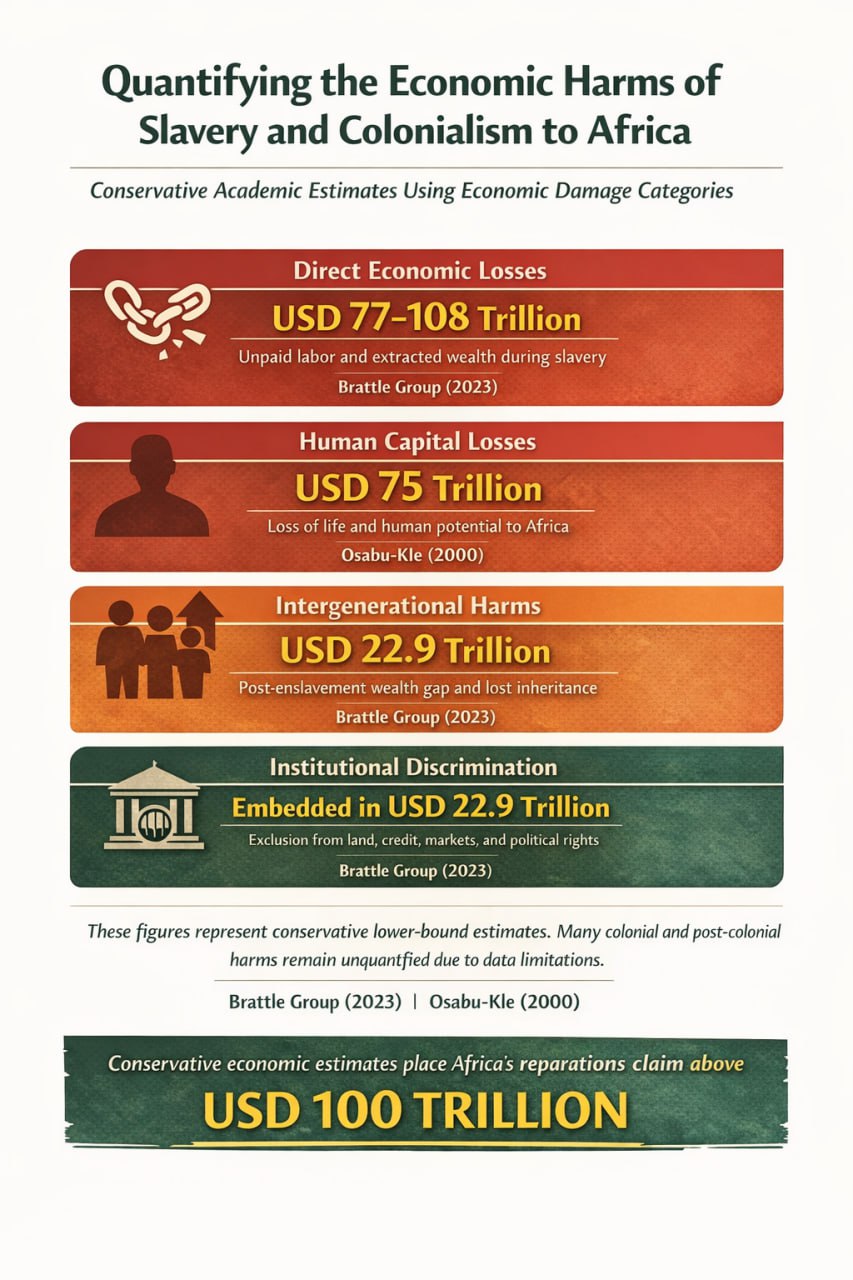
The approach adopted by the PPF repositions reparations as a question of material loss and structured liability, grounded in quantifiable harms capable of being pursued through enforceable claims rather than rhetorical recognition.
The Pan-African Progressive Front’s research approach is anchored in what it describes as damage assessment.
At the centre of this work is Sumaila Mohammed, blogger and head of the Economic Desk of the Front, who plays a leading role in translating historical injustice into economic frameworks capable of quantifying loss across generations.
His work focuses on converting centuries of extraction, dispossession, and enforced underdevelopment into measurable economic harm that can serve as the basis of credible and defensible reparations claims.
In a recent interview, Sumaila outlined the political stakes of the current phase of the reparations struggle, situating Africa’s demands within a wider global movement that is increasingly shifting from symbolism to substance.
“When you look at the current fight some organisations, like CARICOM, which truly understand its essence, demand an apology first. These are harms that have caused the African continent losses beyond measure. Reparations are our rightful due. The money owed for the crimes committed is more than they could ever pay, even if they tried. But we must start somewhere.”
His intervention reflects a broader recalibration underway within Pan-African reparations politics, one that insists that moral clarity must now be matched with economic evidence, institutional strategy, and enforceable claims grounded in historical fact.
The review sought to clarify four major pillars of harm: direct economic extraction, human capital destruction, intergenerational deprivation, and institutionalised exclusion after enslavement.
Each category reveals how underdevelopment was imposed, not inherited.
According to some estimates, the cost of direct economic extraction is calculated in line with unpaid labour, the damage has been valued at approximately USD 5.9–14.2 trillion within the years 1619–1865.
Similarly, when assessed through the lens of human life losses, the damage has been valued at approximately USD 75 trillion, according to Daniel Tetteh Osabu-Kle, reflecting the immense toll of premature deaths, shortened life expectancy, and the systematic erosion of African human capital resulting from slavery and colonial domination.
Likewise, taking the analysis even further, one of the most expansive evaluations places the overall cost of harm beyond trillions, accounting for centuries of economic plunder, the loss of cultural heritage, the entrenchment of intergenerational poverty, and the deliberate structuring of long-term underdevelopment.
“The figures quantify the situation of poverty with indicators…the problem lies in how to rethink the development model for Africa beyond the quantitative,” added the Ambassador while commenting on the work of the PPF.
The preliminary work by the Front states that, “An often-cited figure of $777 trillion, advanced in 1999 by the African World Reparations and Repatriation Truth Commission, emerged from a political and moral accounting of centuries of harm rather than a formally published economic valuation model.” As such, many Africans believe there is an urgent need for precise and systematic calculations of these harms, so that the struggle can move beyond speculation and rough estimates toward evidence-based demands for justice.
This is precisely why the Pan-African Progressive Front is working tirelessly to establish itself as a central hub for Reparations advocacy, grounded in rigorous research, clear economic analysis, and the active mobilisation of African and diasporan peoples.
By uniting the continent and the diaspora under the unbreakable banner of African unity, the PPF is aiming to build a collective force that can no longer be ignored, diluted, or compromised, ensuring that the demand for justice remains firm, organized, and irreversible.
From these discussions, one point stands clear: concrete initiatives are urgently needed. Debt cancellation, the return of stolen artifacts, and other tangible measures must begin to meaningfully compensate African peoples for historical and ongoing harms inflicted by Western powers.
Because, in truth, it is our inherent right to reclaim all that was taken from us: our labour, our resources, our dignity, and our future.
There are no ambiguities or alternatives. Justice delayed is justice denied, and the call for reparations is not negotiable—it is a rightful claim rooted in history, law, and the unyielding will of African people everywhere.
Explore the world of impactful news with CitiNewsroom on WhatsApp!
Click on the link to join the Citi Newsroom channel for curated, meaningful stories tailored just for YOU:
https://whatsapp.com/channel/0029VaCYzPRAYlUPudDDe53x
No spam, just the stories that truly matter! #StayInformed #CitiNewsroom #CNRDigital