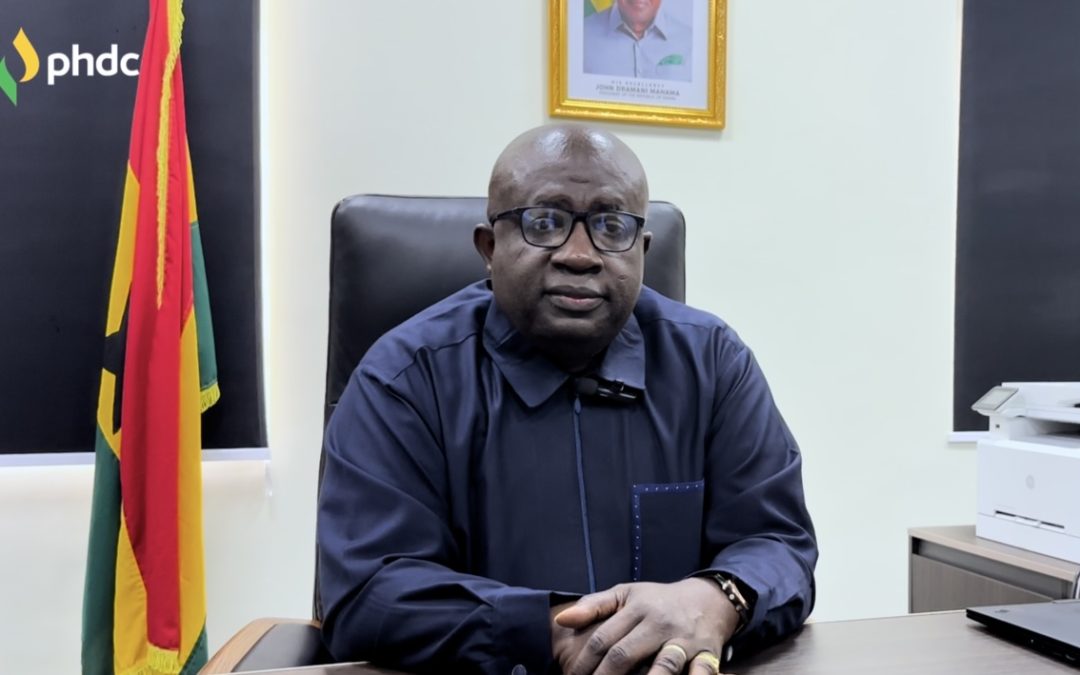
The Chief Executive Officer of the Petroleum Hub Development Corporation, Dr. Tony Aubynn, has disclosed that approximately $100 million will be required to compensate affected landowners under the Petroleum Hub project.
The compensation component forms a critical part of the land acquisition process for the project, which is a key pillar of the government’s strategy to position Ghana as a regional petroleum and petrochemical hub.
Dr. Aubynn disclosed in a sideline interview with the media after a strategic engagement between the Corporation and Civil Society Organizations.
He explained that while compensation is mandatory under Ghana’s legal framework, payment may not be made entirely as a lump sum, as alternative models are being considered to manage the financial burden and ensure sustainability.
According to him, the Minister of Energy and Green Transition, together with other government stakeholders, is working to design an appropriate framework to commence the compensation process in line with legal requirements.
“Because of the reduction in the size of the land, we have to re-compute the figures [for compensation], but we are looking at around GH¢900 million. Between GH¢800 and GH¢900 million which in dollar terms is $100 million dollars,” he said.
“I have told you that the President himself has asked questions about why that money has not been made available, for which reason my minister is actively trying to resolve any bottleneck that must has been the reason.
“I can’t tell you off the top of my head [when compensation will be done], but I can tell you that we are working very hard on this. My minister is working hard in fashioning a model that can begin to pay the compensation. You don’t need to pay everything at one go, but there should be a model that commits the entity to pay compensation,” Dr. Tony Aubynn added.
The CEO also revealed that President John Mahama has directed a reduction in the total land size for the project from 20,000 acres to 13,000 acres, equivalent to roughly 5,000 hectares. The revision is expected to influence both the compensation bill and the overall land development strategy for the hub.
The Petroleum Hub project is designed to attract large-scale investment into refining, petrochemicals, storage and related infrastructure, with the compensation framework seen as a foundational step toward unlocking full-scale implementation.