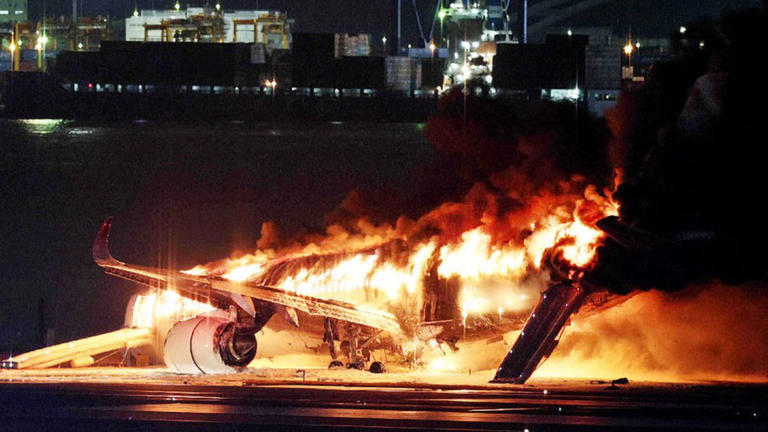
Passengers dashed to the emergency exits of a burning Japan Airlines jet without their hand luggage, in compliance with the flight crew’s instructions.
Leaving their valuables behind was a “major factor” behind the swift evacuation of all 379 people on board, right before the aircraft was engulfed in flames on the runway of Haneda Airport in Tokyo last Tuesday, aviation experts say.
Japan Airlines Flight 516 turned into a fireball after it collided with a coastguard plane as it landed. Five of the six people on board the smaller aircraft died.
The flawless evacuation on the Japan Airlines jet has astounded the world and won praise from many. Aviation experts and flight crew tell the BBC it boiled down to the flight crew putting their rigorous training in place and “well-behaved” passengers who obeyed safety protocols.
“I don’t see a single passenger on the ground, in any of the videos I’ve seen, that has got their luggage with them… If people tried to take their cabin luggage, that’s really dangerous because they would slow down the evacuation,” said Prof Ed Galea, director of the Fire Safety Engineering Group at the University of Greenwich.
The state of the aircraft, an Airbus A350, made the evacuation difficult, Prof Galea said.
“This accident was far from ideal. The aircraft was nose down, which meant it was difficult for passengers to move,” he said.
Only three inflatable slides could be used to evacuate passengers but they were not properly deployed because of how the jet landed. The slide was very steep, which could have been dangerous.
The aircraft’s announcement system also malfunctioned during the evacuation, so the flight crew had to convey instructions using a megaphone and by shouting, Japan Airlines said.
One passenger sustained bruises and 13 others requested medical consultations due to physical discomfort, the airline said.
The Japan Airlines jet departed from Sapporo’s New Chitose airport at 16:00 local time (07:00 GMT) and landed at Haneda shortly before 18:00. The smaller coastguard aircraft was due to deliver aid to victims of a powerful New Year’s Day earthquake. An investigation into the collision is underway.
Safety training kicked in
A former Japan Airlines flight attendant told the BBC that passengers on the commercial flight were “incredibly fortunate”.
“I felt relieved to find out that all the passengers were safe. But when I started thinking about the emergency evacuation procedure, I suddenly felt nervous and fearful,” she said. “Depending on how the two planes collided and how the fire spread, it could have been a lot worse”.
In real life situations, it could be difficult to ensure that passengers do not panic, said the former flight attendant, who spoke on the condition of anonymity
“But what they achieved is harder than one can imagine. The fact that they managed to get everyone to escape is a result of good co-ordination among crew and passengers following instructions,” she said.
She said new crew members undergo stringent evacuation and rescue training for up to three weeks before they are allowed to serve in commercial flights. The training is repeated every year.
“We go through a written exam, case study discussions and practical training using different scenarios, such as when the plane has to make a water landing or if there is fire on board. Maintenance staff are also involved in such training,” said the former flight attendant, who left the company 10 years ago.
A pilot for a South East Asian airline, who also spoke on the condition of anonymity, said the rigorous training that the flight crew had undergone helped with the speedy evacuation.
“I must say it was amazing. I think what happened in this case was that the training kicked in. You really don’t have time to think in a situation like this, so you just do what you were trained to do,” he said.
In order for any passenger aircraft to be internationally certified, aircraft manufacturers must show that everyone aboard can leave the plane within 90 seconds. Evacuation tests sometimes involve actual passengers, he added.
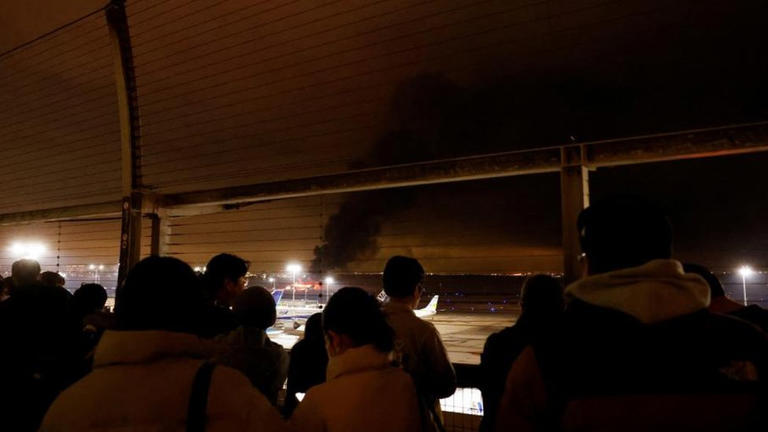
The pilot added that aviation safety regulations had been significantly strengthened after past mishaps.
For instance, the collision of two Boeing 747 jets at Los Rodeos Airport in Spain in 1997 – which killed 583 people and remains the deadliest accident in aviation history – led to a review of cockpit procedures and radio communications. The crash was found to be due to miscommunication between flight crew and air traffic controllers.
Japan Airlines experienced its own catastrophe in August 1985, when Osaka-bound Flight 123 crashed into a mountain shortly after take off from Tokyo Haneda. It was later attributed to faulty repair work by Boeing, the aircraft manufacturer. Only four out of 524 people on board initially survived the crash, but one of them eventually succumbed injuries.
In 2006, Japan Airlines opened a museum-like facility near Haneda displaying wreckage from the incident, aimed at promoting safety awareness among its employees.
“In face of the pain and grief of the bereaved families and public distrust in airline safety [after the 1985 crash], we pledged that we would never again allow such a tragic accident to occur,” Japan Airlines wrote on the facility’s webpage.
“Every staff is reminded that valuable lives and property are entrusted to us in our work.”
Additional reporting by Mariko Oi